


Steps to take after a home insurance non-renewal notice in Tampa
A non-renewal notice doesn’t end coverage immediately. For Florida personal-lines and commercial residential property policies, the insurer must give the first-named insured at least 120 days’ written notice before nonrenewal takes effect, according to the Florida Legislature. The steps to take after a home insurance non-renewal notice in Tampa begin with reviewing the reason and end date, then arranging replacement coverage before the current policy expires.
It’s understandable to wonder whether a non-renewal notice means your home is suddenly uninsured or whether you have time to respond. This article explains what non-renewal means, when a policy can end mid-term, and how to look for new coverage without leaving a gap. You’ll learn what to review in the notice and which details matter when comparing replacement policies, so you can make informed decisions about timing and coverage.
Table of Contents
1. Can my Florida homeowners insurance be cancelled mid-term?
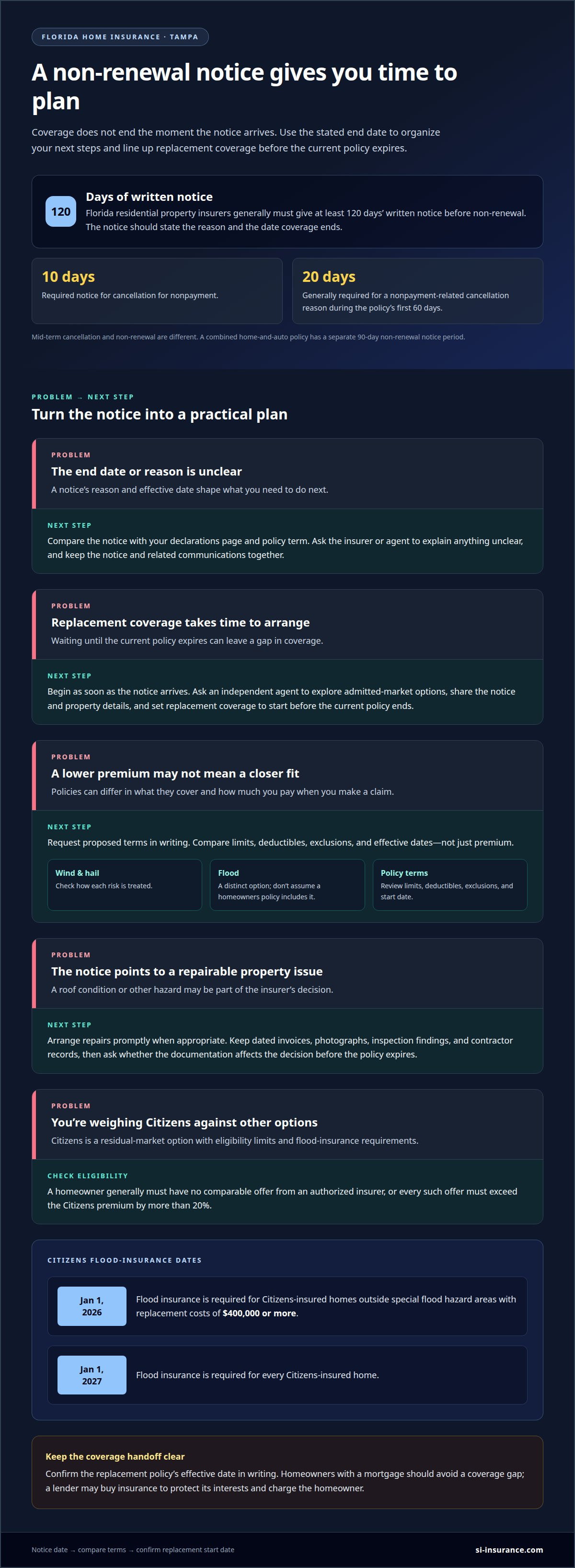
A mid-term cancellation ends a policy before its scheduled expiration; non-renewal means the insurer won’t continue it afterward. Florida residential property insurers generally must give homeowners at least 120 days’ written notice before cancellation or non-renewal, and the notice must state the reason. For nonpayment, the required notice is 10 days. During the first 60 days of a policy, cancellation for a reason other than nonpayment generally requires 20 days’ notice.
After a Florida residential property policy has been in force for 60 days, cancellation is limited to specified grounds. These include nonpayment, a material misstatement, or a substantial change in risk. The distinction matters: an insurer’s decision not to renew at the policy’s expiration is different from ending coverage during the term. A combined home-and-auto policy has a separate 90-day non-renewal notice period.
A non-renewal notice is a written statement that the insurer plans to end coverage on a future date rather than offer another policy term. Multiple claims, particularly those filed close together, may contribute to that decision. Read the notice for its effective date and stated reason, then ask the insurer or agent what prompted the decision and whether corrective steps could address it.
Florida law limits certain claim-based non-renewals. An insurer generally can’t use an act-of-God claim as the reason if the homeowner completed prevention steps the insurer requested. A single water-damage claim also can’t be the sole cause of non-renewal. The stated reason matters: a notice based on claim history may need to be assessed differently from one citing roof condition or another property issue.
If you think a notice was late or insufficient, contact your insurer to clarify when coverage ends and what premium applies. Homeowners with a mortgage should avoid a coverage gap, because a lender may buy insurance to protect its interests and charge the homeowner. Keep the notice and related communications together, and use the stated end date to plan replacement coverage.
2. Time to find coverage after a non-renewal notice
Begin arranging replacement coverage as soon as the notice arrives. The steps to take after a home insurance non-renewal notice in Tampa start with identifying your current policy’s end date and planning backward from it. Ask an independent agent to explore admitted-market options while there’s time to review applications and proposed terms. Aim to start replacement coverage before the current policy ends.
An independent agent can submit your home’s risk to multiple admitted insurers and explain differences in underwriting standards. Share the notice, property details, and records of roof repairs or other upgrades. These materials help insurers assess the home’s condition and understand the non-renewal. Request proposed limits, deductibles, exclusions, and effective dates in writing, then compare how each policy addresses your needs.
Review wind, hail, and flood protection separately. A replacement policy may treat these risks differently, so identify which protections are included, excluded, or available separately. Flood insurance is a distinct option to consider for a Tampa home. Assess whether it fits the property’s flood exposure and financing needs rather than assuming a homeowners policy includes that protection.
Citizens Property Insurance Corporation is a residual-market option with eligibility limits. A homeowner generally must have no comparable offer from an authorized insurer, or every such offer must exceed the Citizens premium by more than 20 percent.
Citizens’ flood requirements also affect the coverage decision. Starting January 1, 2026, flood insurance is required for Citizens-insured homes outside special flood hazard areas with replacement costs of $400,000 or more. Starting January 1, 2027, every Citizens-insured home must have flood insurance. Pursue admitted-market options promptly while considering Citizens eligibility, applicable flood requirements, and the effective date needed to avoid an interruption in coverage.
3. What Does a Home Insurance Non-Renewal Mean?
A non-renewal means the insurer plans to end your insurance policy on its expiration date, rather than offer another term. For personal lines and commercial residential property policies, insurers must give the first-named insured at least 120 days’ written notice before nonrenewal takes effect, according to the Florida Legislature. The notice should identify the reason and the date coverage ends.
Review those details together. Compare the notice’s effective date with your declarations page and current policy term, then ask the insurer or agent to explain any unclear reason. Florida also requires advance notice of the renewal premium 45 days before renewal. That premium notice is separate from a non-renewal notice, so don’t mistake one for the other.
Non-renewal reasons may involve property condition, underwriting changes, or claims history. Multiple claims, especially those made close together, can contribute to a decision. However, Florida generally bars an insurer from relying on an act-of-God claim when the homeowner completed prevention steps the insurer requested. A single water-damage claim also can’t be the sole reason for non-renewal.
If the notice cites roof condition or another repairable hazard, arrange the work promptly and keep dated invoices, photographs, inspection findings, and contractor records. Documentation of roof repairs, replacement, and weather-mitigation measures can help show an insurer that the property’s condition has changed. Send relevant proof to the insurer or agent and ask whether it affects the decision before the stated expiration date.
Tenure matters to cancellation rules, but non-renewal means coverage ends at the term boundary. After a Florida residential property policy has been in force for 60 days, cancellation is limited to specified statutory grounds, including material misstatement, nonpayment, or substantial risk change. A “fair plan” is not a universal label for replacement coverage. Florida homeowners should assess Citizens eligibility and available coverage options rather than assume a particular program applies.
4. Meaning of a home insurance non-renewal
A non-renewal is an insurance company’s decision not to offer another term for a particular home. It describes what happens to that contract, not a finding that the property can never be insured. For example, if a notice cites a roof concern, document repairs and present the home’s updated condition when seeking coverage. The stated reason provides context, but it doesn’t automatically determine what options are available next.
This distinction helps homeowners separate three issues: the existing policy, the insurer’s underwriting decision, and a future application. A non-renewal ends the current arrangement on its effective date. Another insurer makes a separate decision based on the property information and its own underwriting standards. A notice doesn’t mean every company will reach the same conclusion about the home.
Read the notice as a specific communication, not a general assessment of your finances or insurability. If it names property condition, identify the feature involved, such as the roof, and gather records showing its current state. If it refers to claims, organize the relevant claim details and any completed prevention measures. Don’t assume credit caused the decision unless the insurer identifies it as the reason.
Treat the notice as a prompt for targeted action. Match the stated reason to evidence you can provide, such as dated repair records, photographs, or inspection documents. If the insurer’s explanation appears to describe the wrong property or an outdated condition, ask the insurer or agent to clarify the information used. A clear correction can keep the discussion focused on your home and its current condition.
Some insurers consider homeowners’ financial circumstances when evaluating applications, but that is distinct from the reason stated in a non-renewal notice. Keep these questions separate as you prepare for replacement coverage. The notice concerns the insurer’s decision about the current policy; a future application involves a new underwriting review. This distinction helps you respond to the actual reason without treating one company’s decision as a final judgment on your home.
SI Insurance: Home Insurance
Si Insurance Agency helps homeowners explore home insurance after a non-renewal notice. Contact the agency while your current policy is still active to discuss the stated reason, your property’s condition, and the coverage you need in a replacement policy.
Bring the notice and relevant property information to the conversation. Details about repairs, claims, and the policy’s end date help frame your coverage needs. If your home and vehicle coverage also need attention, Si Insurance Agency offers Home Insurance and Auto Insurance.
For help exploring home insurance options after a non-renewal, contact Si Insurance Agency.
Make your next coverage decision with purpose
A non-renewal can be a useful opportunity to reassess how your home is protected, rather than simply replacing one policy with another. Consider how you use the property, which risks matter most to your household, and whether the coverage you pursue reflects those priorities. For Tampa homeowners working through the steps to take after a home insurance non-renewal notice, clear records of the home’s condition and your coverage needs can keep the next conversation focused.
Si Insurance Agency offers Auto Insurance, Motorcycle Insurance, and Boat Insurance alongside home coverage, which may be useful when you’re considering protection for more than your house. Your immediate priority is to arrange suitable replacement coverage before the existing policy ends, while choosing coverage that fits your circumstances.
Discuss your home insurance needs with SI Insurance, and take the next step with a clearer plan.
Frequently Asked Questions
What Does a Home Insurance Non-Renewal Mean?
A non-renewal means your current insurer won’t continue the policy for another term. It doesn’t, by itself, determine whether another insurer will cover the home. For example, a notice citing a roof issue concerns the current insurer’s underwriting decision; repair records can help explain the home’s present condition in a new application. Keep the notice with your policy documents as you plan the transition.
How long do I have to find new coverage after a non-renewal notice?
Florida homeowners generally receive at least 120 days’ written notice before a residential property policy is non-renewed, according to the Florida Legislature. That period is advance notice, not extra coverage after the policy’s stated end date. Start seeking replacement coverage when the notice arrives, and coordinate its effective date so it begins before the existing policy ends.
What do I do when I receive a notice of nonrenewal from my Insurance company?
Read the notice for its reason and effective date, then contact the insurer or agent to clarify anything unclear. Gather relevant records, such as roof invoices, photographs, inspection documents, or claim information. Begin arranging replacement coverage, and tell your mortgage servicer if an escrow or premium issue may affect the policy. Keep correspondence together so your next application can address the stated concern clearly.
Can an insurer non-renew me because I filed a claim?
Claims history can affect a non-renewal decision, particularly when multiple claims are filed close together. Florida generally bars an insurer from using an act-of-God claim as the reason when the homeowner completed prevention steps the insurer requested. A single water-damage claim also can’t be the sole cause. Keep claim records and prevention documentation organized so the stated reason can be considered in context.
Can my Florida homeowners insurance be cancelled mid-term?
Yes, but Florida limits when an insurer can cancel a residential property policy during its term. Nonpayment generally requires 10 days’ notice; cancellation for another reason during the first 60 days generally requires 20 days’ notice. After the policy has been active for 60 days, cancellation is limited to specified grounds, including nonpayment, material misstatement, or substantial change in risk.
What Happens If You Let Coverage Lapse?
A lapse leaves the home without insurance protection against covered losses during the gap, and future insurers may be less likely to offer coverage. If you have a mortgage, the lender will likely buy force-placed insurance to protect its interest and charge you for it. That coverage protects the mortgage loan balance, not necessarily your full property interests. Avoid a gap by aligning replacement coverage with your current policy’s end date.
Comments