


Renters Insurance in St. Petersburg: What a Landlord Can Require
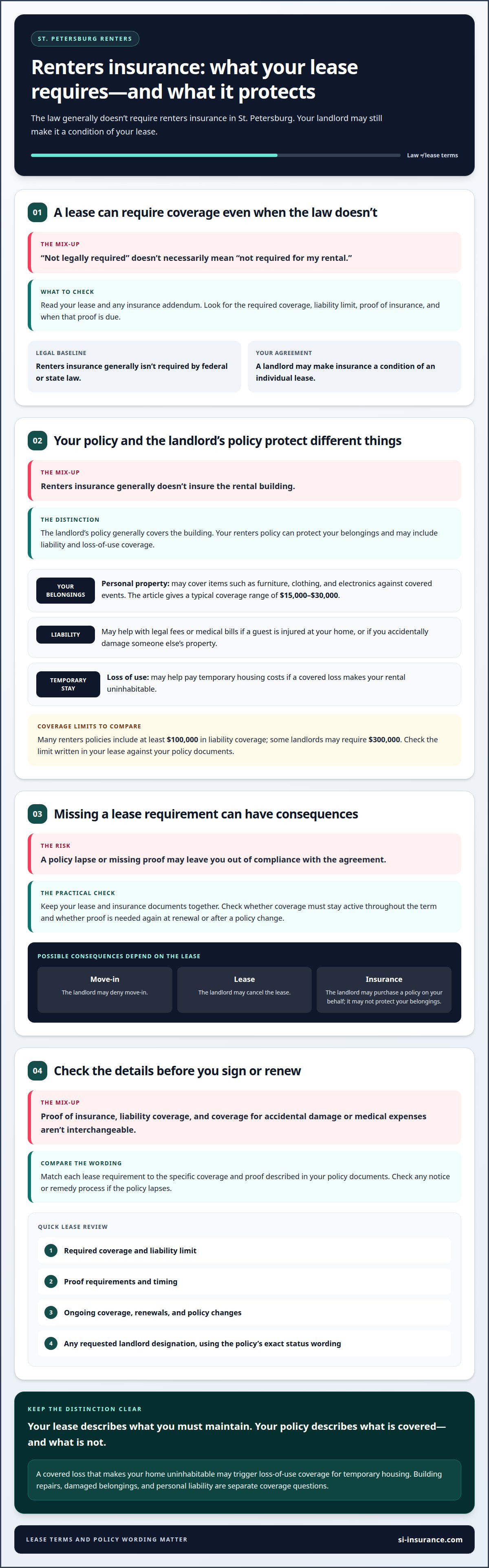
A lease can require renters insurance even when the law doesn’t. In St. Petersburg, renters insurance generally isn’t required by law, but a landlord can make it a lease condition. If your landlord requires renters insurance, your lease will spell out the coverage and proof your landlord requires.
It’s reasonable to ask whether that policy protects the rental itself. Usually, it doesn’t: renters insurance is intended to protect your belongings and may include liability coverage, while the landlord’s policy generally covers the building.
This guide explains what to look for in your lease, how personal property and liability coverage differ, and when additional living expenses may help pay for temporary housing after a covered loss makes your home uninhabitable. You’ll also learn what your landlord may require you to maintain, so you can understand the terms before choosing coverage.
Table of Contents
Does Renters Insurance Cover the Landlord’s Property?
Renters insurance generally protects your belongings, not the landlord’s building. The U.S. Census Bureau describes renter’s property insurance as covering contents and potentially including liability coverage.
Policy Coverage and Exclusions
A renters policy may cover personal belongings against events such as fire, theft, vandalism, and certain water damage. Common exclusions include flood damage, earthquakes, pest infestations, normal wear and tear, and intentional damage. The policy determines which events are covered and which are excluded.
Personal property coverage applies to items such as furniture, clothing, and electronics. Renters’ personal property coverage typically ranges from $15,000 to $30,000. If a covered fire makes your rental uninhabitable, loss-of-use coverage may help pay temporary housing costs. Valuable jewelry or electronics may need additional personal articles coverage for replacement protection.
Renters Insurance Versus Tenant Liability
Renters insurance is a broader policy that can combine personal property, loss-of-use, and liability protection. Tenant liability coverage refers to the liability portion, not protection for your belongings. A landlord’s insurance policy typically covers the rental building, but not a tenant’s furniture or electronics if they’re stolen or damaged.
Liability coverage may help with legal fees or medical bills if a guest is injured at your home, or if you accidentally damage someone else’s property. Many renters policies include at least $100,000 in liability coverage, while some landlords may require $300,000. A lease may require you to keep coverage active throughout the term and provide proof, sometimes before move-in. Check its stated limit and proof requirements against your policy documents.
Renters Insurance: Legal Requirement or Lease Condition?
Renters insurance generally isn’t required by federal or state law in the United States. St. Petersburg renters aren’t generally required by law to insure a rental home, but a landlord may make coverage a condition of a particular lease. That distinction separates a broad legal requirement from an obligation in an individual rental agreement.
Insurance as a Lease Condition
A lease condition is a requirement tenants agree to meet under their rental contract. A landlord may require renters insurance even when the law doesn’t generally require tenants to carry it. If your St. Petersburg landlord requires coverage, check the lease for the required coverage, liability limit, proof, and timing.
Requirements may also apply beyond move-in. Keep your lease and insurance documents together so you can check whether your current policy meets the terms, including any updated proof needed at renewal or after a policy change.
Consequences of Noncompliance
If you don’t obtain insurance required by the lease, the landlord may have the right to deny move-in, cancel the lease, or purchase a policy on your behalf. The consequences depend on the lease, and a policy purchased by the landlord may not protect your personal property.
A lapse can leave you without the coverage your lease requires. Check the agreement for any notice or remedy process, and make sure you understand the requirements before signing.
Also note whether the lease distinguishes proof of a renters policy from coverage for accidental damage or medical expenses. These protections aren’t interchangeable, so compare the specific coverage required with your policy documents.
For a practical starting point, explore renters insurance options alongside your lease. Comparing the written requirement with the policy details can help clarify whether the conditions are met.
Additional living expenses
If a covered loss makes your St. Petersburg apartment uninhabitable, loss-of-use coverage may help pay temporary housing costs. For instance, after a covered fire, you may need another place to stay while repairs are underway. This coverage addresses temporary living arrangements, not building repairs or replacement of damaged belongings.
Your policy determines which expenses qualify and sets the payment limits. Read the loss-of-use section alongside your personal property coverage: one concerns temporary housing after displacement, while the other addresses covered damage to belongings. A claim must involve a covered loss that makes the rental uninhabitable.
A landlord or property manager may be listed as an interested party on a renters policy if the insurer allows it. This is different from naming the landlord as an additional insured, so don’t treat the designations as interchangeable. If your lease asks for the landlord to be listed, interested-party or additional-interest status is generally the relevant request, rather than additional-insured status.
Listing a landlord as an interested party doesn’t insure the building under your policy. The landlord’s policy generally covers the structure, while your renters policy covers your own needs, including belongings and, after a covered loss, potentially temporary housing through loss-of-use coverage. Personal liability is separate and doesn’t provide additional living expenses.
If your lease asks for a landlord designation, compare its exact wording with the status options in your policy. Keep your proof of coverage and relevant policy details together, so the requested designation and your own protection are clear during a claim or repair period.
Whether renters insurance is legally required
Renters insurance generally isn’t required by federal or state law in the United States. St. Petersburg renters aren’t generally required by law to insure a rental home, but an individual landlord may make coverage a condition of a specific lease. The legal baseline and the agreement you sign are separate considerations.
A landlord may require renters insurance in the lease, making it a contractual obligation rather than a rule for all renters. Read the signed agreement and any insurance addendum for the required coverage, liability limit, proof, and timing. For example, a clause may require proof before move-in and active coverage during the tenancy. Those written terms define the landlord’s requirements.
The distinction also matters if a rental requirement changes. When a renewal or lease amendment adds an insurance condition, compare the new wording with the previous agreement. Check whether it changes the required limit, proof deadline, or period when coverage must remain active. The policy’s terms still matter, because a requirement to carry insurance doesn’t describe every protection it provides.
Keep the requirement in context: a lease condition applies to that rental agreement, while the general legal position applies broadly to tenants. If your agreement requires coverage, treat its terms as part of your tenancy obligations. If it doesn’t include such a clause, don’t assume a general legal mandate applies instead. This helps St. Petersburg renters distinguish a landlord’s written requirement from a rule for every rental property.
To review coverage in light of your rental requirements, explore renters insurance options.
SI Insurance: Renter Insurance
SI Insurance Agency offers Renter Insurance to help renters consider coverage that fits their lease requirements and personal property needs. It’s relevant when a landlord requires proof of coverage or specifies liability terms. Compare the policy’s coverage and documentation with the lease, including any stated limits and required coverage period.
Knowing the difference between renters insurance and the landlord’s building coverage helps clarify what each policy addresses. SI Insurance Agency also offers Auto Insurance and Motorcycle Insurance for separate risks; neither replaces renters coverage.
If you’re ready to discuss renters coverage for your situation, contact SI Insurance.
Make Your Next Coverage Decision With Confidence
Use your lease as a starting point for reviewing your household’s coverage. Consider whether your belongings, liability needs, and the landlord’s written terms still align when you renew your policy or your living situation changes. If you’re deciding what a landlord requires for renters insurance and what you need in St. Petersburg, focus on a policy that addresses the lease and your circumstances.
SI Insurance Agency also offers Auto Insurance, Motorcycle Insurance, and Boat Insurance for other parts of your life. These policies don’t replace renters insurance, but considering your needs together can help you identify the risks you want to address.
For help considering renters coverage, contact SI Insurance. Taking a closer look can help you choose coverage that fits your rental and priorities.
Frequently Asked Questions
Can a landlord enforce the required coverage amount?
A landlord may make a minimum coverage amount a condition of the lease, and tenants should treat the written requirement as part of the rental agreement. Whether a particular term is enforceable depends on the lease and applicable law. Read the clause for its required liability limit, proof deadline, and coverage period rather than assuming a general insurance rule sets the amount.
Does renters insurance cost vary by state?
Yes, renters insurance costs can vary by state and policy details. Location, selected coverage limits, insured belongings, and the insurer’s rating factors can affect the premium. For example, two renters choosing different personal property limits may receive different quotes, even in the same state. Compare policy details, not just the premium.
What Is Tenant Liability Insurance Coverage?
Tenant liability coverage may protect you if you’re legally responsible for certain injuries or property damage. For instance, an injured guest or accidental damage to someone else’s property may involve this coverage, subject to the policy terms and limit. It doesn’t replace protection for your own belongings, so consider those needs separately.
What should tenants prepare before getting renters insurance through an insurance agency?
Bring your lease or insurance addendum, rental address, and the landlord’s coverage requirements. An inventory of your belongings, including electronics and valuable items, can help you determine an appropriate personal property limit. Note any existing policies and when coverage needs to begin. These details give an insurance professional useful context for discussing options and preparing proof that reflects the lease terms.
What are some other common options for renters?
You may consider adjusting personal property or liability limits and reviewing whether valuable belongings need additional protection. Separate coverage may also be relevant for risks excluded from a standard renters policy, such as flood damage. The right combination depends on your lease, property, and belongings. Review each option’s terms so you understand its purpose.
What if my apartment floods?
Standard renters insurance commonly excludes flood damage, so damage to belongings caused by flooding may require separate coverage. Depending on the policy and cause, certain accidental water damage may be treated differently. For example, water escaping from an appliance and rising floodwater aren’t necessarily covered in the same way. Review the policy’s water-damage wording before relying on it for flood losses.
Comments