


How to Not Worry About Surprise Insurance Costs in Florida
Updated: 3 days ago
Surprise medical bills aren’t always yours to absorb. For covered emergency care and certain services at in-network facilities, federal protections generally limit insured patients to in-network cost-sharing; some out-of-network air ambulance services are also covered. The No Surprises Act’s protections took effect January 1, 2022, for health plans that begin on or after that date, according to the Centers for Medicare & Medicaid Services.
It’s understandable to worry that an unexpected bill or denied claim could leave you facing costs you didn’t anticipate. Learning how to feel less worried about unexpected insurance costs in Florida starts with understanding which protections apply and what steps to take if a bill seems incorrect.
This guide explains how federal protections and Florida rules work, what to do when a medical bill may violate them, and how to challenge a bill or appeal a denied claim. It also explains where these protections have limits, so you can approach a notice or explanation of benefits with a clearer plan.
Table of Contents
How does the No Surprises Act protect me?
The No Surprises Act limits certain out-of-network charges when a patient has little or no choice of provider. Its protections work alongside existing program and Florida rules.
Emergency care protections
The No Surprises Act generally limits what insured patients pay for covered emergency care to their in-network cost-sharing, even when the emergency provider is out of network. The Centers for Medicare & Medicaid Services states that the Act’s surprise-billing protections became effective in the United States on January 1, 2022. Health plans generally must cover emergency services without prior authorization, and post-stabilization care may also qualify unless the patient consents in writing to waive protections.
Services covered by federal protections
Federal balance-billing protections cover most emergency services, certain non-emergency services at in-network hospitals and ambulatory surgical centers, and out-of-network air ambulance services. At an in-network facility, covered services can include emergency medicine, anesthesia, pathology, radiology, laboratory, neonatology, assistant surgeon, hospitalist, and intensivist care. Patients may receive these services from clinicians outside their health plan’s network. Florida has limited state-level protections against out-of-network ground ambulance balance billing, so those charges may need separate attention.
Protections for privately insured patients
People with group or individual health insurance plans receive federal protections for covered surprise bills. When balance billing is prohibited, patients generally owe only in-network cost-sharing, such as copayments, coinsurance, and deductibles. Plans generally calculate emergency and out-of-network cost-sharing using the in-network amount and count eligible payments toward deductibles and out-of-pocket limits. Medicare, Medicaid, TRICARE, the Indian Health Service, and the Veterans Health Administration already protect people from surprise bills from participating providers and facilities. For those seeking guidance on navigating health, hospital indemnity, or Medicare plan decisions to better prepare for out-of-pocket costs, Wonderfully Made Blessings provides supportive insurance resources.
For Florida homeowners in 2026, premiums depend on property characteristics, location, selected coverage, and deductible; this section’s medical-billing protections don’t determine homeowners insurance prices.
Florida homeowners should understand how their policy applies hurricane deductibles and windstorm coverage, since those terms affect out-of-pocket costs after covered damage.
Citizens Property Insurance costs and eligibility depend on its underwriting and rating criteria, as well as the coverage and property details used for the policy.
Policy exclusions, coverage limits, deductibles, and expenses above covered amounts can lead to unexpected out-of-pocket costs for Florida homeowners.
To prepare for premium increases, deductibles, and assessments, homeowners can review renewal documents, set aside funds for policy cost-sharing, and budget for possible changes.
How federal and state surprise billing laws interact
Federal and state rules work together: the No Surprises Act sets a minimum level of consumer protection, while state laws may add protections for certain plans or services. The applicable rule can depend on the patient’s plan, provider, and type of care.
A balance bill is a provider’s charge for the difference between its billed amount and the amount a health plan allows. Surprise billing means an unexpected out-of-network bill, often after emergency treatment or care at an in-network facility. A deductible or coinsurance amount listed by the plan is different: it is cost-sharing, not automatically an unlawful balance bill.
Florida law adds protections for PPO patients. Under Fla. Stat. § 627.64194, out-of-network providers generally cannot bill PPO patients beyond in-network cost-sharing for covered emergency care or certain non-emergency services at in-network facilities. The protections followed Florida’s SB 1264, effective Jan 2020. Florida’s HMO rules also bar providers from collecting amounts that are the HMO’s responsibility under Fla. Stat. § 641.3154. Ground ambulance billing remains a notable gap in Florida’s limited state protections.
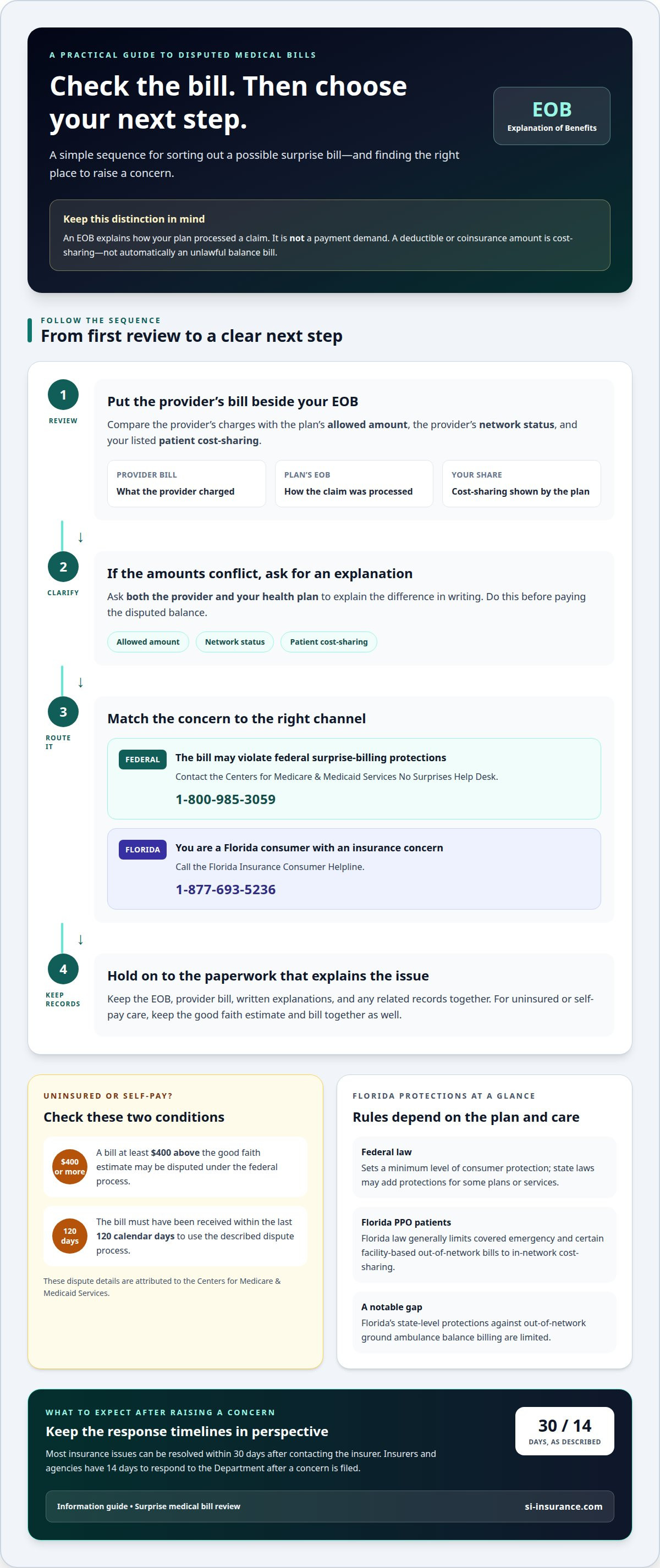
For a payment dispute, compare the provider’s bill with the plan’s explanation of benefits, then ask the insurer to explain any difference in allowed charges or cost-sharing. If the bill appears to violate federal protections, contact the Centers for Medicare & Medicaid Services No Surprises Help Desk at 1-800-985-3059. Florida consumers may call the Florida Insurance Consumer Helpline at 1-877-693-5236. Most insurance issues can be resolved within 30 days after contacting the insurer, and insurers and agencies have 14 days to respond to the Department after a concern is filed.
To assess an insurer’s financial strength, review its financial-strength ratings and regulatory financial disclosures; those address financial capacity, not whether a specific claim was handled correctly. For separate home or vehicle policy questions, explore home and auto insurance options.
Disputing surprise bills and appealing denied claims
Start by separating the provider’s bill from your health plan’s Explanation of Benefits (EOB). An EOB summarizes how the plan processed a claim; it is not a payment demand. Compare the allowed amount, network status, and patient cost-sharing with the provider’s charges. If the amounts conflict, ask the provider and plan to explain the difference in writing before paying the disputed balance.
For uninsured or self-pay patients, a bill at least $400 above the good faith estimate may be disputed under the federal process, according to the Centers for Medicare & Medicaid Services. If you are uninsured or self-pay, consider asking for a cost estimate when arranging care. The bill must have been received within the last 120 calendar days to use the described dispute process. Keep the estimate, bill, and related care records together; they help show what was quoted and charged.
For insured patients, an unexpected bill may result from out-of-network care, cost-sharing, or a claim denial, and each calls for a different response. Review the EOB’s denial reason, then contact the health plan using the appeal instructions in its notice. Explain which decision you dispute and include relevant records, such as the bill, EOB, referral, or prior authorization. Request the plan’s written decision and keep copies of correspondence and payment records. Paying while a dispute is pending does not, by itself, settle whether the charge was correct.
One-third of insured adults ages 18-64 said their family received an unexpected medical bill in the previous two years after care they thought was covered. That makes careful claim review worthwhile, particularly when a network provider’s name differs from the facility’s. If a Florida hospital billing grievance remains unresolved, hospitals must respond within 7 business days. For suspected federal surprise-billing violations, contact the CMS No Surprises Help Desk at 1-800-985-3059. Clear documentation helps distinguish a protected surprise bill from a claim that needs an appeal.
What counts as a surprise medical bill
A surprise medical bill is an unexpected charge from an out-of-network provider, often for health care a patient believed was covered. It can arise after emergency services or at a facility where the patient chose an in-network hospital but did not select every clinician involved. A deductible or coinsurance amount assigned under the health plan is different from a provider’s balance bill.
An unfamiliar amount is not automatically a surprise bill protected by law. Review the bill and Explanation of Benefits together, noting the provider, service, network status, allowed amount, and patient cost-sharing. For example, a charge may reflect the plan’s deductible rather than an out-of-network balance. Learning how to not worry about surprise insurance costs in Florida starts with identifying the type of charge. If the provider’s bill seems to exceed the plan’s responsibility, request an itemized bill and compare its entries with the claim decision.
Unexpected medical bills can be difficult to absorb at different income levels. Among insured adults ages 18-64, 45% said they could not immediately afford an unexpected $500 medical bill. Among insured adults in that age group with household incomes under $40,000, 72% reported they could not immediately afford the same expense. By contrast, 54% of insured adults ages 18-64 said they could pay an unexpected $500 bill in full or pay off a credit-card charge by the next statement. Knowing which charges deserve closer review can make the next step clearer.
Florida’s time limit for medical debt also matters, but it does not determine whether a bill is valid. As of July 2024, the statute of limitations for medical debt from Florida hospitals and ambulatory surgical centers is 3 years. Keep bills, EOBs, and payment records organized; dates and provider details can clarify the history if a billing dispute continues.
Medical-billing protections address health care charges, not other forms of household protection. If you’re reviewing a separate long-term coverage need, explore whole life insurance options.
SI Insurance
SI Insurance helps Florida residents consider how auto, motorcycle, boat, or home coverage fits their broader protection needs. The No Surprises Act applies to certain health care bills, while these policies cover different risks. Keeping those categories distinct helps set realistic expectations about what each policy is intended to protect.
If an unexpected medical bill raises wider questions about your household’s insurance, identify the other risks you want to address, such as damage to your home or a vehicle accident. SI Insurance offers coverage options for those needs, helping you consider protection in the context of your circumstances rather than treating medical-billing rules as a substitute for other insurance.
For a conversation about your insurance needs, contact SI Insurance.
Build a Clearer Plan for Your Coverage
Understanding how to not worry about surprise insurance costs in Florida begins with separating medical-billing concerns from the other risks your household needs to manage. Disputing a bill calls for a careful review of the charge and claim decision; planning for future protection means considering which policies fit your circumstances and what each is intended to cover.
SI Insurance offers Auto Insurance, Motorcycle Insurance, and Boat Insurance for people considering those distinct coverage needs. These policies address risks different from health care billing, so understanding their purpose can help you make more organized insurance decisions.
Before deciding whether to dispute a bill, compare the charge with the claim decision. If you’re also reviewing other coverage needs, contact SI Insurance to discuss your circumstances.
Frequently Asked Questions
What should I do if I receive a surprise bill and have a billing disagreement?
Pause before paying a disputed amount and gather the documents related to the charge. Keep the provider bill, your health plan’s Explanation of Benefits, any good faith estimate, and related correspondence together. Then contact the provider’s billing department and your plan with a specific question, such as why a service was processed as out of network. Written records make it easier to track responses and any revised balance.
Does the law cover me in all situations?
No. Federal surprise-billing protections apply to specified services and circumstances, not every unexpected health care charge. For example, Florida has limited state-level protection against out-of-network ground ambulance balance bills. A patient who chooses an out-of-network provider in circumstances where notice and consent rules apply may have different protections. The key details are the type of service, facility, health plan, and whether a valid waiver applies.
What insurance costs can surprise Florida residents?
Unexpected costs can include health plan deductibles, copayments, coinsurance, or services the plan does not cover. Outside medical care, Florida residents may also face premiums, deductibles, or costs above coverage limits for auto, home, or boat insurance. These expenses arise under different policies and are not all governed by surprise medical-billing protections. Review renewal documents and coverage terms to understand which costs belong to each policy.
What insurance policy exclusions and limits commonly lead to unexpected out-of-pocket costs in Florida?
For Florida homeowners, policy exclusions, coverage limits, deductibles, and costs above covered amounts can lead to unexpected out-of-pocket expenses. Hurricane deductibles and windstorm coverage terms can also affect what you pay after covered damage.
Comments