


How to File a Renters Insurance Claim for Theft in Jacksonville
You come home in Jacksonville and notice a drawer left open, a missing laptop, or signs that someone has entered your rental. Before trying to reconstruct every detail, make sure it’s safe to be inside and report the theft to police. Knowing how to file a renters insurance claim for theft in Jacksonville starts with a clear account of what happened, supported by records you can share with your insurer.
It’s understandable to wonder whether your stolen belongings are covered, or to worry that you’ll forget something important or make a mistake when reporting the loss. Coverage depends on your policy’s terms, limits, exclusions, and deductible, so a theft doesn’t automatically mean every missing item will be reimbursed. A careful inventory and timely communication can help you present the claim clearly.
This guide walks through the practical steps: securing your situation, documenting the theft and missing property, notifying your insurer, and responding to requests for information. It also explains how coverage terms and the insurer’s review can shape what happens next, so you can move forward with a more organized understanding of the process.
Table of Contents
What to Do First After a Theft in Your Jacksonville Rental
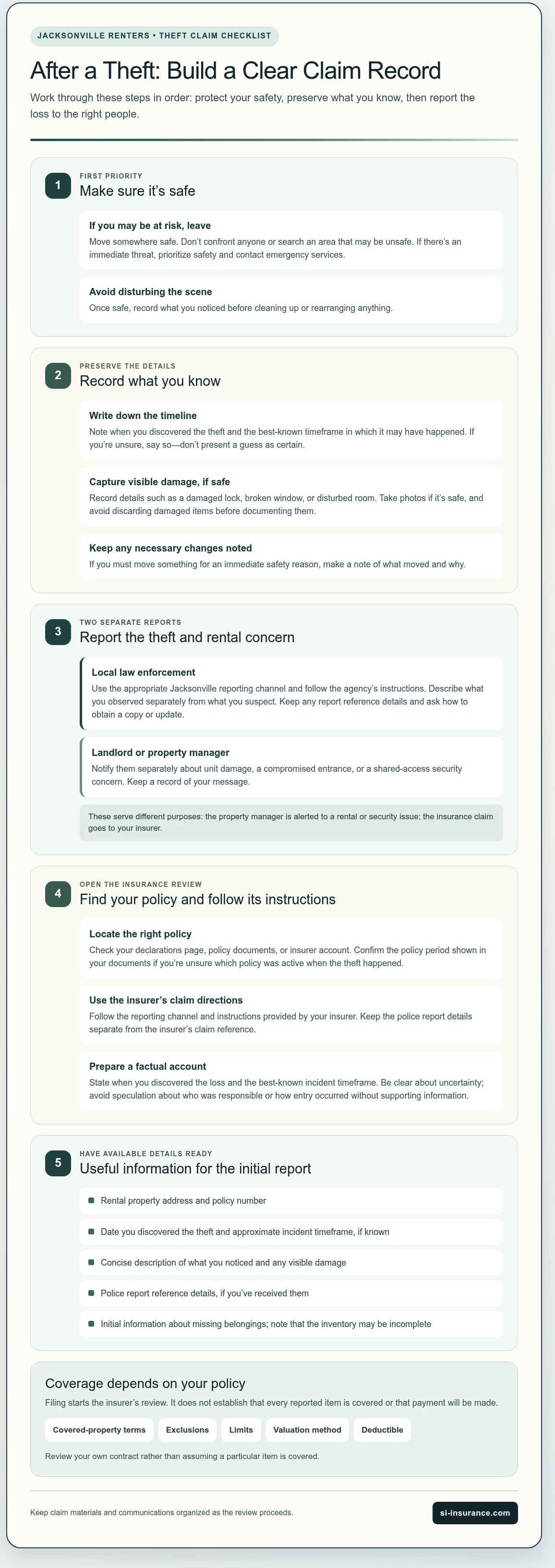
Discovering that someone has been in your home and taken your belongings can leave you shaken and unsure what to do next. Take the steps in order: get to a safe place, note what you know about the discovery, report the theft through an appropriate local law-enforcement channel, and notify your property manager about any damage or security concern. Once you’re safe, these early details can help you explain what happened to your insurer without relying on memory alone.
A theft report doesn’t automatically mean your insurer will pay for every missing item. The outcome depends on the policy’s covered-property definitions, exclusions, limits, and deductible. Renters policies can differ, so review your own contract rather than assuming a particular item is covered. For a general overview of renters insurance, see Understanding Renters' Insurance.
Make the scene safe and record what you know
If you see signs that someone may still be inside, or you otherwise feel at risk, leave and move somewhere safe. Don’t confront anyone or search a potentially unsafe area. Once safe, write down when you discovered the theft and the best-known timeframe in which it may have occurred. If you don’t know exactly when it happened, say so; an honest estimate is more useful than a guessed date presented as certain.
Before cleaning up or rearranging anything, record relevant details, such as a damaged lock, broken window, or disturbed room. Take photos if it’s safe to do so, and avoid discarding damaged items until you’ve documented them. If something must be moved to address an immediate safety issue, note what was moved and why. This creates a basic record without requiring you to investigate or draw conclusions about how the theft occurred.
Report the theft and notify the property manager
Use the appropriate reporting channel provided by local law enforcement in Jacksonville, and follow the agency’s instructions. If there’s an immediate threat, prioritize getting to safety and contacting emergency services. When you report the incident, describe what you observed and distinguish that from what you suspect. Keep any report reference details the agency provides, and ask how to obtain a copy or update if you’ll need one for your records.
Notify your landlord or property manager separately if the theft involved damage to the unit, a compromised entrance, or a concern about shared building access. Share the practical information needed to address the property or security issue, and keep a record of your message. This notice serves a different purpose from an insurance claim: it alerts the property manager to conditions affecting the rental, while your claim is submitted to your insurer under your policy. If you’re working out how to file a renters insurance claim for theft in Jacksonville, keeping those communications distinct can help you track what was reported to each party.
At this stage, focus on preserving details, not deciding whether the loss is covered. Your insurer will assess the claim against the policy, and the next section explains how to begin that process.
How to Start a Renters Insurance Theft Claim in Jacksonville
Once immediate safety and reporting steps are underway, the next task is to open a claim with the insurer named on your policy. The process may differ by company, so rely on the instructions attached to your own policy rather than assuming a particular app, phone number, or response schedule applies.
A renters insurance theft claim is a request for your insurer to review a reported loss under the terms of your policy. Filing starts that review; it doesn’t, by itself, establish that every reported item is covered or that payment will be made.
Find your policy and the insurer’s claim instructions
Locate your declarations page, policy documents, or insurer account information. These should help identify the company that issued the policy and provide a way to find its claim-reporting instructions. If you’re unsure which policy was active on the date of the theft, check the policy period shown in your documents before submitting the report. Keep the policy number and insurer contact details together for reference.
Follow the claims channel and directions provided by that insurer. If you need to revisit local reporting information, the Jacksonville Sheriff’s Office is the appropriate place to consult for Reporting Theft to Jacksonville Police. Keep the law-enforcement report details separate from the insurer’s claim reference, since each relates to a different report.
Give a clear, factual account of the theft
Before contacting the insurer, prepare a brief account using what you already know. State when you discovered the loss and the best-known timeframe in which it may have happened. If you can’t narrow down the incident window, say that directly. Avoid presenting an estimate as a confirmed fact, and don’t speculate about who was responsible or how entry occurred unless you have information that supports it.
For the initial report, have these details ready where available:
The rental property’s address and your policy number
The date you discovered the theft and the approximate incident timeframe, if known
A concise description of what you noticed and any visible damage
Police report reference details, if you’ve received them
Initial information about missing belongings, with a note that the inventory may need follow-up
The insurer may ask for additional information or supporting records as it reviews the claim. You don’t need to guess at details to make the first report; explain what’s known, identify what remains uncertain, and ask how to provide further documentation as you locate it.
Locate the policy. Confirm the insurer and find the policy’s claim instructions.
Use the stated claims channel. Submit the report through the method specified for your policy.
Describe the loss accurately. Give the discovery date, known timeframe, and factual account, then record the claim reference and any follow-up instructions.
Keep the claim reference with your policy records so it’s easy to identify later communications. If you’re reviewing protection for a future rental, you can explore renters insurance options separately from the claim you’ve already reported.
How to Document Stolen Belongings for a Jacksonville Renters Claim
A clear inventory turns the difficult task of remembering what’s missing into a record the insurer can review item by item. Start with what you can recall, then add details as you find supporting records. You don’t need to have every receipt in hand before organizing the list or continuing with the claim process.
Build an item-by-item inventory
Work through the rental by room or category, such as electronics, clothing, or kitchen items. For each missing belonging, note its description, brand or model if known, estimated age, and approximate purchase details. Add the value you’re estimating and how you arrived at it, such as a remembered purchase price or a comparable item’s current listing. Label figures as estimates rather than exact amounts if you can’t verify them.
A simple table can help keep the inventory consistent and show what evidence is already available versus what you may still need to locate:
These examples illustrate a format, not a required valuation method. Don’t omit an item just because one detail is uncertain; mark the gap clearly and update it if you later find better information.
Gather supporting records without delaying the report
Search for documents and images that may help establish ownership or clarify an item’s details. Useful records can include receipts, photographs, bank or card statements, order confirmations, warranties, and other purchase or ownership evidence. A photograph may help identify a model or show that an item was in your home, while a transaction record may help narrow down when it was purchased. Neither needs to be treated as proof of every detail.
Already available: Save relevant photos, receipts, statements, warranties, and police report information you have on hand.
Still to locate: Mark records you may be able to retrieve from email, online accounts, or stored paperwork, and note which item each record relates to.
Keep copies of claim communications and organize the materials digitally or on paper in the format the insurer requests. Missing receipts don’t, by themselves, establish whether a claim will be accepted or denied. The insurer evaluates the information submitted under the policy, so provide an accurate account and distinguish documented facts from estimates. This kind of organized record can make how to file a renters insurance claim for theft in Jacksonville feel more manageable, even when some purchase details take time to recover.
What to Review Before Accepting or Challenging a Theft Claim Decision
A police report confirms that a theft was reported, but it doesn’t by itself establish that a renters policy covers the loss or requires payment. The insurer reviews the circumstances and submitted information against the specific contract, so a request for additional documents should not automatically be read as a denial.
The policy’s terms and the insurer’s claim decision govern the outcome. Review the written explanation alongside the policy, especially if the decision excludes certain belongings, limits payment for a category of property, or applies a deductible or valuation method you didn’t expect. This is a practical way to understand how to file a renters insurance claim for theft in Jacksonville and assess the insurer’s response without relying on assumptions about what a policy usually covers.
Understand deductible and valuation language
A deductible is the amount applied under the policy before a payment for a covered loss is calculated. The effect depends on the policy’s terms and the insurer’s assessment of the covered loss. For example, if the documented amount for covered belongings is close to the deductible, the deductible may substantially affect the amount payable. That example is general, not a prediction of how a particular claim will be settled.
Valuation also depends on the wording of your contract. A policy may specify how the insurer assesses an item’s value, and you shouldn’t assume the amount will automatically equal the cost of buying a new replacement. Compare the insurer’s valuation with your inventory and supporting records, then review the policy language that applies. Check whether the decision addresses each item, any relevant limit, and the deductible before deciding what questions to raise.
Respond methodically to questions or an unfavorable decision
An information request means the insurer is asking for material to continue or clarify its review; it isn’t necessarily a final coverage decision. Note exactly what’s requested, the date, how you responded, and what records you provided. If the insurer issues a decision you don’t understand, ask for the specific policy wording and claim information supporting it. Keep the explanation and your correspondence with your claim records.
Before challenging a decision, compare the stated reason with the relevant policy provision and the evidence submitted. If a document is unavailable, explain that plainly and ask whether another record could address the question. Avoid sending inconsistent estimates or changing an item’s description without explaining why; if new information corrects an earlier detail, identify the correction and its basis.
These steps help keep the review focused on the contract and the facts, rather than on assumptions about standard coverage. For future planning, you can explore renters insurance options separately from the insurer’s decision on an existing claim.
After Filing: Follow Up on Your Jacksonville Theft Claim and Review Future Coverage
Submitting a claim is one step in the process, not the end of it. A consistent follow-up routine helps you see what has been sent, what the insurer still needs, and what instructions apply next. Keep the current loss and any later review of your coverage as separate tasks: the insurer handles the existing claim under its process and your policy, while a coverage review helps you consider protection for future needs.
Keep the claim organized while it is being reviewed
Use one file, digital or paper, for the claim reference, submitted inventory, supporting records, police report information, and correspondence. Keep copies of anything you send, along with the date and method of submission. If the insurer requests additional material, follow the channel and format provided for the claim, and note when you respond. A simple record of each exchange can prevent confusion if you need to revisit a question later.
Track requests: Note what the insurer asked for and whether you’ve supplied it.
Record communications: Keep dates, names or departments when provided, and the substance of each conversation.
Clarify next steps: If you’re unsure whether anything remains outstanding, ask the insurer what it needs or what procedural step comes next.
There isn’t one follow-up schedule that applies to every policy or insurer. The next steps and timing depend on the insurer’s claims process, the information under review, and the terms of your policy. If you receive an update you don’t understand, ask for clarification and add the response to your file rather than relying on memory.
Review renters coverage after a theft
Once attention to the immediate loss allows, use the experience to review whether your current coverage still reflects your belongings and circumstances. Consider whether the personal property limit appears aligned with what you own, and read the policy’s deductible, exclusions, and any special limits that apply to particular types of property. This is a future-planning exercise, not a way to change the terms governing a claim already filed.
An updated home inventory may also make a future review more practical. Keep descriptions and purchase records for belongings you acquire, and revisit the list when your possessions change. The goal is to understand the policy wording and identify questions for a future coverage discussion, not to assume that a higher limit or a particular option is automatically right for every renter.
If you’re considering coverage for a future rental, you can explore renters insurance options through SI Insurance. Keep that conversation separate from follow-up on the existing theft claim, which should continue through the insurer handling it. Together, a well-organized claim file and a thoughtful review of future needs can make the process of how to file a renters insurance claim for theft in Jacksonville more manageable from first report through follow-up.
Make Your Next Coverage Review More Informed
A theft can change how you think about the belongings you keep at home and the records you have for them. Use that insight to make future coverage decisions deliberately, with a current sense of what you own and how your policy describes its protection. Understanding how to file a renters insurance claim for theft in Jacksonville is also a useful foundation for asking clearer questions when reviewing coverage later.
SI Insurance offers renters insurance to customers across Florida. If you’re considering protection for a future rental, explore renters insurance options and take the next step toward coverage that reflects your needs. A thoughtful review now can help you feel more prepared going forward.
Frequently Asked Questions
Is theft covered by renters insurance in Jacksonville?
Renters insurance may cover stolen personal belongings, but coverage depends on the policy and circumstances of the loss. Check how the contract defines covered property, along with exclusions, category-specific limits, and the deductible. For instance, an item may be treated differently from the rest of your belongings if the policy sets a special limit for that type of property. The insurer reviews the reported loss under the policy terms.
What should I do first if someone steals my belongings from my Jacksonville rental?
First, move to safety if you’re concerned someone may still be nearby or the rental may be unsafe. Don’t confront anyone. Once safe, report the theft through an appropriate Jacksonville law-enforcement channel, then notify your insurer using the claim instructions for your policy. If you’re deciding how to file a renters insurance claim for theft in Jacksonville, keep confirmed observations separate from assumptions about when or how the theft happened.
Can I file a renters insurance claim if I do not have receipts for stolen items?
Yes, you can report a loss even if you can’t find receipts for every item. Receipts are one possible record, not the only information an insurer may review. A dated photograph, an order confirmation, or a bank statement could help support an item’s description or purchase history. Explain what you can document and identify any details you’re estimating. Missing receipts alone don’t determine whether the claim will be accepted or paid.
How long do I have to file a renters insurance theft claim in Florida?
In Florida, you generally have one year from the theft date to give notice of a new renters insurance claim. A supplemental claim for additional damage has a separate deadline of 18 months from the date of loss. These are notice deadlines, so don’t assume that waiting to gather every supporting record is necessary before telling the insurer about the theft. Review your policy and report the loss promptly.
What happens if my renters insurance theft claim is denied?
A denial should come with an explanation of the insurer’s decision. Read it alongside the relevant policy language and check whether the insurer relied on information you believe is incomplete or inaccurate. You can ask the insurer to identify the specific policy provisions supporting its decision and explain any review options available through its process. If you provide a correction or additional record, keep a copy and note how it relates to the stated reason.
Should I file a renters insurance claim if the stolen items are worth less than my deductible?
If the estimated value of the covered loss is below your deductible, the claim may not result in a payment, but the deductible isn’t the only policy detail to consider. Check whether the estimate reflects all missing belongings and whether any policy limits affect the calculation. If you’re uncertain how the deductible applies, ask the insurer how it evaluates the reported loss before deciding what to do, and follow the policy’s claim instructions.
Comments