


Frontline Insurance alternatives for South Florida properties
The lowest quote isn’t automatically the strongest alternative. Compare Frontline Insurance alternative property quotes in South Florida using the same dwelling and liability coverage, hurricane deductible, exclusions, and policy terms. Consider Citizens and FAIR Plan options, too, when assessing available property coverage.
It’s understandable to focus on the premium first, but a quote tells only part of the story. Differences in hurricane coverage, deductibles, and exclusions can affect how a policy responds when a property is damaged.
This guide explains what to compare in policy documents, how South Florida’s hurricane exposure can affect your decision, and where Citizens and FAIR Plan options fit. You’ll have a clearer framework for judging whether another quote offers a meaningful coverage alternative, not just a different price.
Table of Contents
Comparing coverage, deductibles, exclusions, and policy terms
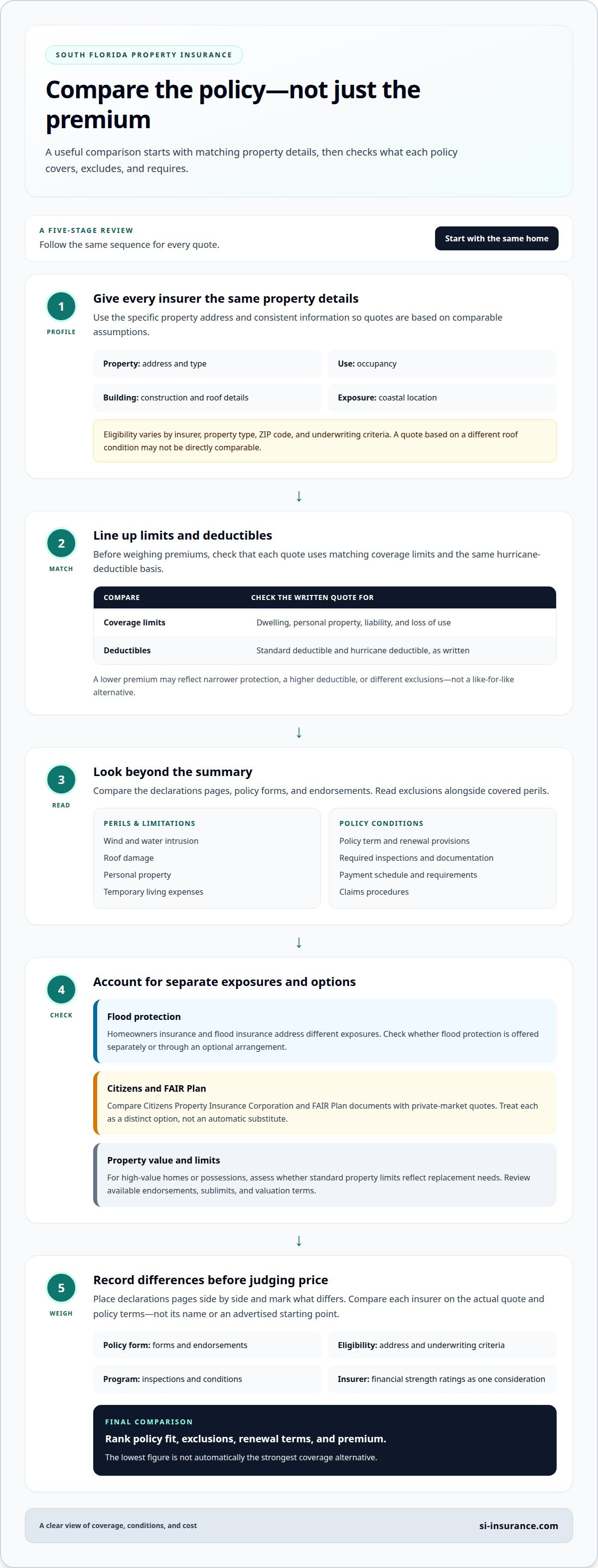
Use the same property details for every quote: address, occupancy, construction, roof, and requested limits. Compare dwelling, personal property, liability, and loss-of-use coverage side by side. A lower premium may reflect narrower protection, a higher deductible, or different exclusions, rather than a like-for-like alternative.
Eligibility varies among insurers by property type and ZIP code in South Florida. Each carrier assesses the location, occupancy, construction, roof condition, and coastal exposure. Compare quotes for the specific home, condominium, or rental property at its address.
When comparing Florida Peninsula Insurance Company and State Farm, review the actual quote and policy terms rather than assuming coverage, pricing, or availability are uniform. Premiums depend on property characteristics, selected limits, deductibles, and underwriting factors. Before comparing premiums, check that the quotes use matching coverage limits and the same hurricane-deductible basis.
Review exclusions alongside covered perils. Note any limits or conditions involving wind, water intrusion, roof damage, personal property, and temporary living expenses. Compare the policy term, renewal provisions, payment schedule, and required inspections, too. An independent comparison can organize these differences without treating a carrier’s name as a measure of suitability.
Give flood coverage separate attention. Homeowners insurance and flood insurance address different exposures, so check whether flood protection is offered separately or through an optional arrangement. For high-value homes or possessions, assess whether standard property limits reflect replacement needs, and review any available endorsements, sublimits, or valuation terms.
Coverage: Match dwelling, contents, liability, and loss-of-use limits.
Deductible: Compare the standard and hurricane deductibles as written.
Exclusions: Read the policy language for wind, water, and roof limitations.
Terms: Review renewal conditions, inspections, and payment requirements.
For a practical comparison, place the declarations pages side by side and mark every difference before weighing premiums. This makes Frontline alternatives easier to assess for protection, deductible exposure, exclusions, and policy conditions, rather than price alone.
Comparison with other insurers
Compare each insurance company using the same property profile, not an advertised starting point. For a South Florida home, provide its address, occupancy, roof details, and requested limits. Consistent information helps owners distinguish a genuine alternative from a quote based on different assumptions. Comparing Frontline Insurance alternative property quotes in South Florida is more useful when every carrier receives the same details.
Florida Peninsula Insurance Company and State Farm can serve as comparison points, but assess each quote on its own terms. Availability and pricing depend on the property and underwriting criteria. A carrier’s name alone doesn’t show whether its policy fits a particular home.
Use the same review process for each insurer. Record the quote date, property details, proposed limits, deductible structure, and policy term. Note differences in inspections, renewal conditions, and claims procedures. This can reveal practical trade-offs that a premium comparison alone may miss.
Ratings: Review an insurer’s financial strength ratings as one consideration when assessing its capacity to meet obligations.
Policy form: Compare the actual forms and endorsements, not just summary descriptions.
Eligibility: Record whether the address and property characteristics meet each company’s underwriting criteria.
Program details: Note any inspections, documentation, or conditions attached to the quoted program.
For example, a quote based on a different roof condition may not be directly comparable. Correct the property information before assessing the result. An independent review can organize insurer responses without assuming every carrier uses identical terms.
After reviewing the quotes, rank priorities such as policy fit, exclusions, renewal terms, and premium. This helps homeowners identify an overall match rather than treating the lowest figure as the default choice. To explore Florida property insurance options, use a structured comparison of the written policy details.
Florida homeowners insurance premiums were calculated for policies with dwelling coverage limits from $300,000 to $800,000 and liability coverage from $100,000 to $300,000. The rate methodology assumes a home construction year of 1980 unless otherwise specified.
For Florida and four other states, U.S. News weights NAIC complaint data at 40%, price at 40%, and customer satisfaction at 20% in its rating methodology. For a Florida commercial property review, Greene & Associates recommends starting with the current policy, statement of values, property schedule, and loss runs.
Florida FAIR Plan and Citizens alternatives
Florida homeowners considering Citizens Property Insurance Corporation or a FAIR Plan option should compare the policy documents with private-market quotes. Treat each as a distinct insurance option, not an automatic substitute for another policy. The property address, occupancy, requested limits, and policy terms shape the comparison. For a coastal home, review how each option describes wind-related damage, water damage, and other covered events.
Start with the declarations page and identify the insured property, coverage limits, deductible structure, and policy period. Then read the exclusions and conditions in the full policy form. For example, if Citizens and a FAIR Plan quote show different personal property limits, record the difference before comparing premiums. Check whether liability coverage is included and whether its limit matches the household’s needs.
Review claims provisions as carefully as coverage amounts. Compare how Citizens and the FAIR Plan describe notice requirements, documentation, inspections, and settlement terms. These details clarify the process after damage and the policyholder’s responsibilities. Keep the current policy beside each alternative and mark changes to covered property, deductibles, exclusions, and claim conditions.
Coverage scope: List the property and events each policy covers, including any stated limits.
Deductible exposure: Record each deductible separately, including any distinct wind-related amount.
Liability: Compare the limit and policy wording across Citizens, the FAIR Plan, and private quotes.
Policy conditions: Note requirements for inspections, maintenance, documentation, and claim reporting.
Use the comparison to identify trade-offs, not to assume one option is broader. Insurance options can differ in their written limits and terms, and quotes may reflect different coverage needs. The relevant measure is the written coverage for the specific property. Before choosing, align the same property details and coverage priorities across every quote, then record the differences on one comparison sheet.
Hurricane and natural disaster insurance risks
South Florida property owners can compare windstorm and hurricane coverage by reviewing available policy options. Policy documents determine covered damage, deductibles, and exclusions. A hurricane can bring wind, rain, storm surge, and flooding, so one policy term may not describe every resulting loss.
Florida’s homeowners insurance nonrenewal rate was 3.35% in 2024. This figure underscores why property owners should assess continuity alongside coverage. For each quote, note the insurer, renewal terms, wind-related deductible, and any property conditions. Then compare how the policy addresses roof damage, water intrusion, and repairs after a covered event. Flood exposure deserves separate review, especially for coastal properties.
Wind: Identify the policy’s hurricane or windstorm deductible and covered damage.
Water: Distinguish rain entering through storm damage from flooding.
Property: Record roof condition, construction, and location details used in underwriting.
Continuity: Review renewal language and conditions tied to inspections or maintenance.
For a commercial building, apply the same review to the property schedule and insured values. Business owners should also consider how storm damage could affect operations, inventory, and recovery plans. Residential home insurance and commercial policies address different property uses, so compare the right policy type before weighing terms. Keep the current declarations page beside each alternative and mark changes in wind, water, and renewal provisions.
Use this review to organize Frontline alternatives around the risks that matter at the specific property. Record unresolved differences, such as a distinct hurricane deductible or separate flood protection, before choosing a policy. To explore South Florida home insurance options, carry the same property details and coverage priorities into the next comparison.
Between 2021 and 2024, Florida's average homeowners insurance premium increased by $2,118, the largest increase in absolute dollars of any state. This adds context to renewal planning.
SI Insurance: Auto Insurance
SI Insurance can help South Florida residents consider home and auto insurance needs after comparing property quotes. Turn to SI Insurance when you want to review those coverage needs with an insurance agency, rather than treating a property quote as the only part of your household’s insurance picture. A home policy comparison clarifies property-specific priorities, while an auto insurance review addresses a separate set of risks and coverage choices.
SI Insurance also offers motorcycle and boat insurance for owners reviewing those vehicles alongside their home. Each policy addresses a different exposure, so keep the coverage details distinct as you assess your overall needs. For a next step, visit SI Insurance online to explore its insurance options.
Make your next coverage review more deliberate
A property insurance decision can also be a useful opportunity to reassess how your household risks are organized. Keep quote comparisons and policy documents together so future reviews can build on the same property details and priorities. A careful review of Frontline Insurance alternative property quotes in South Florida can make the process more considered.
SI Insurance offers Auto Insurance, Motorcycle Insurance, and Boat Insurance for people reviewing protection beyond their property. The next step depends on the coverage you want to assess and the risks you need to address. A focused conversation can clarify those priorities without turning a property comparison into a rushed decision.
Contact SI Insurance about your options and take the next step with a clear view of your coverage needs.
Frequently Asked Questions
What coverage limits, exclusions, and endorsements should homeowners compare in South Florida?
Compare dwelling, personal property, liability, and additional living expense limits against the home’s actual use. After a renovation, consider whether the dwelling limit reflects updated rebuilding needs; a room-by-room contents inventory can reveal gaps in personal property protection. Review endorsements for features such as code-related repairs, and note conditions tied to how the property is occupied or used.
How can South Florida homeowners get and compare property insurance quotes?
Request quotes using consistent property details, then record each insurer’s response in one worksheet. Include the policy renewal date, recent renovations, roof documentation, and prior claim history so you can trace differences to specific information. Organize follow-up questions by policy section and compare written responses with the quote documents. For a South Florida home, this process helps clarify which terms reflect the property’s specific characteristics.
What South Florida property types and ZIP codes do Frontline alternatives cover?
Eligibility varies by insurer and ZIP code. Each carrier assesses the specific property’s address, occupancy, construction, roof condition, and coastal exposure.
Comments