


FR-44 Car Insurance in Florida: DUI Premiums and Coverage
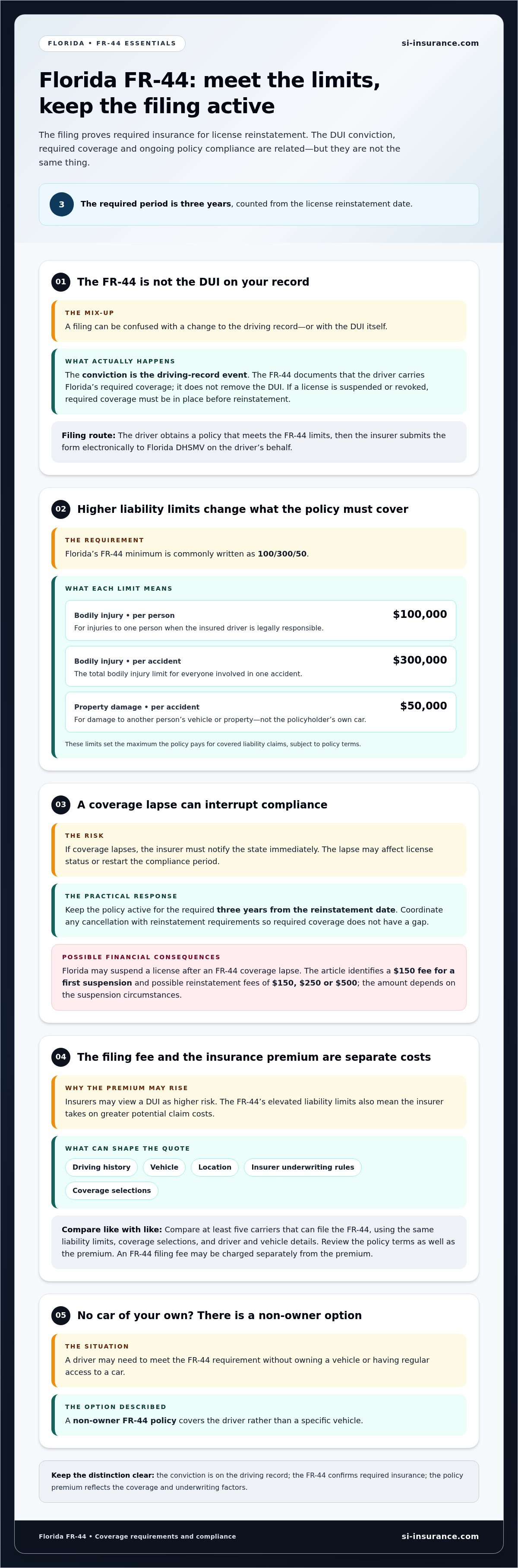
A DUI conviction can affect insurance costs well beyond the initial disruption. In Florida, drivers must file an FR-44 before license reinstatement, and FR-44 car insurance in Florida must meet liability limits of $100,000 per person and $300,000 per accident for bodily injury, plus $50,000 per accident for property damage. The requirement lasts three years from the license reinstatement date.
The filing is only one part of the financial impact. A DUI may lead insurers to view a driver as higher risk, while the FR-44’s elevated liability limits also increase the amount of coverage being insured. As the violation ages, continuous coverage and a clean record can affect how rates change.
This guide explains what the FR-44 does, how Florida’s liability requirements apply, what a DUI can mean for your driving record, and why premiums may rise. It also outlines the factors that shape insurance rates, helping you understand both the filing obligation and its potential effect on your coverage decisions.
Table of Contents
Will FR-44 Insurance Affect My Driving Record?
An FR-44 filing documents that a driver carries Florida’s required coverage after a qualifying DUI conviction. It is separate from the DUI itself: the conviction is the driving-record event, while the filing verifies insurance for license reinstatement. If the license is suspended or revoked, the required coverage must be in place before reinstatement.
The filing process connects the insurer, driver, and Florida DHSMV. The driver obtains a policy meeting FR-44 limits, then the insurer submits the 44 form electronically to the state on the driver’s behalf. This filing confirms financial responsibility; it does not remove the DUI from the driving record. A DUI conviction can trigger the requirement, and an uninsured driver found at fault in an accident involving the stated DUI or DWI circumstances may also need an FR-44.
Keep the policy active throughout the required period. If coverage lapses, the insurer must notify the state immediately, and the lapse may affect your license status or restart the compliance period. Coordinate any cancellation with the reinstatement requirements so you do not leave a gap in required coverage.
Which insurers offer FR-44 insurance in Florida? Insurers that accept drivers needing an FR-44 can submit the filing, but many insurers do not offer FR-44 or SR-22 filings. The insurer must provide the required coverage and file the form with the state.
How long must Florida drivers maintain an FR-44 filing? Drivers must maintain it for three years from the license reinstatement date. A lapse can disrupt that period.
Can I get a Florida FR-44 without owning a car? Yes. A non-owner FR-44 policy covers the driver rather than a specific vehicle, including when the driver has no regular access to a car.
How do DUI penalties and license reinstatement rules relate to Florida FR-44 requirements? A qualifying DUI conviction can lead to a suspended or revoked license and an FR-44 requirement before reinstatement. The filing proves required coverage; it does not replace other DUI penalties.
An FR-44 filing fee may be charged separately from the insurance premium. The premium reflects the higher liability coverage and underwriting factors such as driving history, vehicle, and location, so the filing itself and the policy cost are distinct expenses.
Required liability coverage limits
Florida’s FR-44 certificate requires liability coverage of at least $100,000 for bodily injury per person, $300,000 per accident, and $50,000 for property damage per accident. These limits are commonly written as 100/300/50. They set the maximum the policy pays for covered liability claims, subject to policy terms.
Bodily injury limits apply to injuries to other people when the insured driver is legally responsible. The per-person limit applies to each injured person, while the per-accident limit caps bodily injury payments for everyone involved. Property damage liability covers damage to another person’s vehicle or property, not damage to the policyholder’s own car.
Bodily injury: $100,000 per person and $300,000 per accident.
Property damage: $50,000 per accident.
Higher liability limits can increase insurance rates because the insurer takes on greater potential claim costs. Liability-only coverage and a policy with broader protection can therefore have different premiums. A DUI conviction, driving history, vehicle, location, and insurer underwriting rules can also affect the quoted cost. Compare policies with the same required limits and coverage selections for a consistent comparison.
A lapse can create consequences beyond a change in premium. Florida may suspend a license after an FR-44 coverage lapse; the research figures identify a $150 fee for a first suspension and possible reinstatement fees of $150, $250, or $500. The applicable amount depends on the suspension circumstances. Keeping the policy continuously active helps avoid a filing interruption and its related reinstatement consequences.
How can I compare Florida FR-44 insurance quotes and find affordable coverage? Compare at least five carriers that can file the FR-44, using identical liability limits, coverage selections, and driver and vehicle details. Review the full policy terms as well as the premium, since a lower quote may reflect different coverage.
Florida FR-44 insurance requirements and liability limits
Florida uses an FR-44 certificate to document higher financial responsibility after qualifying DUI cases. The required limits are $100,000 for bodily injury per person, $300,000 per accident, and $50,000 for property damage per accident. An insurance company submits the 44 filing to the state, confirming that the driver’s policy meets Florida’s requirements.
A DUI conviction can trigger the filing before license reinstatement. Florida also requires an FR-44 when an uninsured driver is found at fault in an accident involving the stated DUI or DWI circumstances. The filing concerns proof of insurance, while the conviction and any license suspension remain separate matters. The driver must satisfy applicable reinstatement conditions as well as maintain required coverage.
The Florida Legislature requires Florida drivers to maintain the higher financial-responsibility limits for a minimum of 3 years. The period runs from the license reinstatement date. A coverage lapse can interrupt compliance, so drivers should keep the policy active throughout the required period and ensure the insurance company continues its filing.
FR-44 certificates are used only in Florida and Virginia, but each state has distinct liability requirements. A driver moving between states should not assume that a Florida 44 filing automatically satisfies another state’s rules. The receiving state’s filing requirement and coverage limits determine what must be maintained there.
Florida residents living outside the state may seek a waiver of FR-44 reinstatement requirements by submitting a written non-residency affidavit, proof of an out-of-state ID or driver’s license, and surrendering valid Florida tags and registrations. These documents address residency and vehicle registration, not the underlying DUI conviction.
For quotes, provide each insurance company with the same driver, vehicle, and coverage details, then compare policies that meet the required limits. Confirm that the insurer can submit the Florida filing; a quote without the required 44 filing does not establish compliance.
Auto insurance premium increases after a DUI
A DUI can raise auto insurance rates because insurers assess both driving risk and required financial responsibility. For drivers seeking FR-44 car insurance in Florida, higher liability coverage can increase the insurer’s potential exposure. The conviction can also affect how the driver is classified, even when the filing is current. These are distinct cost pressures: the incident affects risk assessment, while mandated limits affect the policy’s coverage.
The effect can extend beyond the first renewal. A Florida DUI conviction may cause rates to increase dramatically for the next five years. Insurers may review a DUI over a five-to-ten-year look-back period, while lesser violations may remain relevant for three to five years. These periods describe rating considerations, not a guarantee that every insurer uses the same method or timing.
Other details shape the quote alongside the DUI. Florida rates depend on driving record, county, vehicle, age, gender, marital status, and carrier underwriting rules. For example, a driver with a recent accident may receive a different quote from a driver with no additional incidents. The FR-44 requirement and the driver’s broader history are assessed together.
Maintaining continuous coverage and avoiding new incidents can matter as the DUI ages. Rates for FR-44 car insurance in Florida tend to ease over time when coverage stays active and no further violations occur. Lapses can create compliance problems, while new accidents or tickets may add risk signals to the driving record. Keeping coverage uninterrupted avoids an additional complication.
Compare quotes using identical liability limits, vehicles, and coverage selections; otherwise, the lowest premium may reflect less protection. To discuss coverage for your circumstances, explore Florida auto insurance options.
SI Insurance: Auto Insurance
SI Insurance offers auto insurance for Florida drivers reviewing their coverage after a DUI. Once you understand the FR-44 limits and filing period, the next step is to consider how those requirements fit your policy, vehicle, and broader protection needs. Reviewing these details together can help clarify which coverage choices address the state requirement and which relate to your own financial exposure.
Drivers can turn to SI Insurance to discuss auto insurance in light of their circumstances. The agency also offers motorcycle, boat, and home insurance for other coverage needs, though those policies do not replace an FR-44 filing.
To discuss your auto insurance needs, contact SI Insurance.
Make your next coverage decision deliberate
With FR-44 car insurance in Florida, a useful next step is turning the requirement into a clear policy review. Keep policy documents, filing confirmations, and insurer correspondence together, then note any upcoming vehicle or household-driver changes before discussing options. An organized record helps keep the conversation focused on your circumstances, rather than assumptions or outdated details.
Use consistent information when comparing coverage: who drives, which vehicle is insured, and what protection you want to retain. This makes it easier to understand how each option fits your needs. If your circumstances change, review the policy details rather than relying on an earlier comparison. A careful review can help you make the next decision with greater clarity.
For a conversation about your coverage needs, contact SI Insurance. Take the next step at your own pace, with a clearer view of the information that matters.
Frequently Asked Questions
What is FR-44 Insurance?
An FR-44 is a state financial-responsibility certificate tied to an insurance policy, not a separate type of car coverage. In Florida, it demonstrates that a driver carries the liability protection required after certain DUI-related circumstances. The policy provides coverage; the certificate documents that the required limits are in force for the driver’s state compliance obligation.
What's the difference between an FR-44 and an SR-22 form?
Both forms document financial responsibility, but Florida FR-44 requirements call for higher liability limits than an SR-22. An FR-44 policy uses limits of $100,000 per person and $300,000 per accident for bodily injury, plus $50,000 for property damage per accident. An SR-22 generally verifies the state minimum. The filing required depends on the driver’s circumstances and state requirement.
Who Must File an FR‑44 Form?
A driver must file an FR-44 when Florida requires proof of the higher financial-responsibility coverage, commonly following a qualifying DUI conviction. The requirement may also apply to an uninsured driver found at fault in an accident involving the stated DUI or DWI circumstances. The obligation belongs to the driver named in the state requirement, rather than automatically applying to every person on a household policy.
Who needs FR-44 in Florida?
In Florida, a driver whose DUI-related case triggers the state’s FR-44 requirement needs the certificate to meet the associated insurance condition. For example, a driver seeking license reinstatement after a qualifying conviction may need the filing in place. A separate insurance policyholder or family member does not take on that driver’s filing obligation merely by sharing the same address.
How do I submit an FR-44 form?
The driver obtains a policy that meets Florida’s FR-44 limits from an insurer that handles the filing. The insurance company submits the certificate electronically to the Florida state system on the driver’s behalf. For example, buying a policy without the required filing would not document FR-44 compliance, so the filing must accompany the qualifying coverage.
Who Needs FR-44 Coverage?
The requirement applies to the driver ordered to provide FR-44 proof, not only to people who own a car. A driver without a vehicle may need a non-owner policy, which covers the driver rather than a particular car. This can be relevant when someone must meet the filing requirement but has no regular access to a vehicle.
Comments