


Condo Insurance in Florida: A Strategic Guide to Protecting Your Investment in 2026
Updated: Mar 19
If your building's master policy supposedly covers the structure, why did 62% of Florida unit owners find themselves responsible for unexpected repair costs following the active 2024 storm season? You've likely felt the sting of rising premiums and the persistent worry that a single building-wide assessment could destabilize your financial planning. It's a common concern among owners who recognize that the line between personal liability and HOA responsibility is often thinner than it appears. This strategic analysis provides the clarity you need to master condo insurance florida. We'll ensure your coverage is both compliant with the 2026 updates to Florida Statute 718 and robust enough to handle complex risk scenarios.
We're going to bridge the gap between "walls-in" and "all-in" coverage models while providing a blueprint for bespoke risk transfer. You'll gain a calculated plan to mitigate the threat of massive assessments and secure your investment against the evolving legislative landscape of the Sunshine State. By aligning your personal policy with institutional-grade risk management, you can maintain intellectual confidence in your property's long term security.
Key Takeaways
Understand the critical distinction between your association’s master policy and the 'walls-in' requirements mandated by Florida Statute 718 to ensure your interior finishes are properly insured.
Discover how Loss Assessment coverage acts as a strategic shield against the financial burden of shared building deductibles and unexpected community assessments.
Master the nuances of specialized hurricane deductibles and learn why flood protection is a vital component of a modern risk management strategy, even for high-rise owners.
Learn how to protect your home by identifying the specific policy gaps within condo insurance florida that often leave even the most diligent owners vulnerable to unexpected costs.
Explore how a bespoke, independent approach to underwriting provides the stability and foresight required to protect your assets in a volatile market.
Table of Contents Understanding Condo Insurance in Florida: The Strategic 'Walls-In' Concept Florida Statute 718 and Your Legal Insurance Obligations Loss Assessment Coverage: Your Shield Against HOA Surprises Navigating Florida's Hurricane and Flood Realities The SI Insurance Approach: Bespoke Condo Solutions in Florida
Understanding Condo Insurance in Florida: The Strategic 'Walls-In' Concept
Florida's real estate market operates under a unique set of pressures, where the proximity to the coastline and the density of urban centers demand a rigorous approach to risk management. For the sophisticated property owner, securing condo insurance florida isn't merely a box to check for a mortgage lender; it's a calculated move to protect a high-value asset. This individual coverage, technically known as an HO-6 policy, functions as a secondary layer of defense that begins where the association's responsibility ends. Understanding Condo Insurance requires a shift in perspective, moving away from passive ownership toward a "strategic guardian" mindset that anticipates gaps in collective building policies. This proactive stance ensures that your personal sanctuary remains insulated from the financial fallout of building-wide incidents or localized internal failures.
To gain a deeper perspective on how these layers of protection interact and why the market is shifting, watch this analysis of the current environment:
Master Policy vs. Individual Policy: Where is the Line?
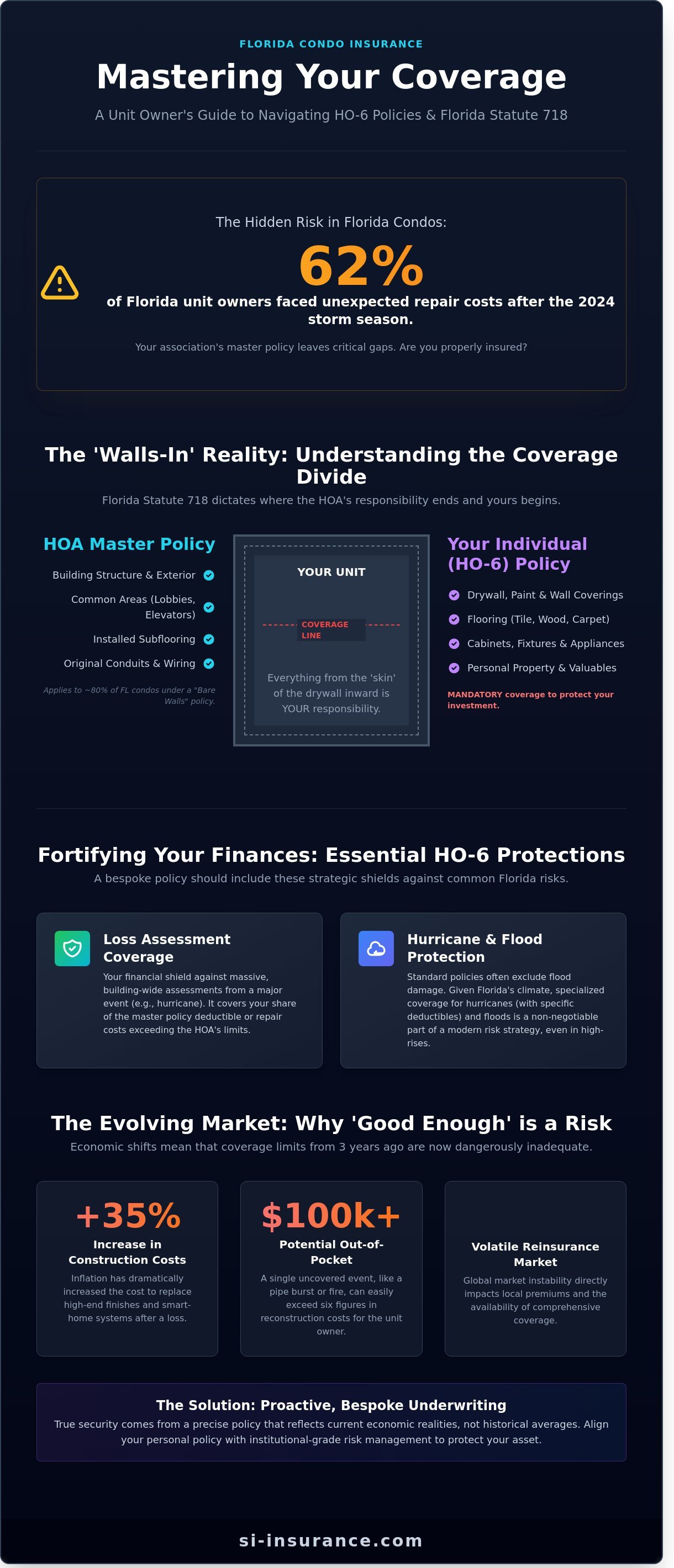
The boundary between your personal liability and the association's coverage is often governed by two distinct structures: "Bare Walls" and "All-In" policies. In a Bare Walls scenario, which currently applies to approximately 80% of Florida condominiums, the master policy only covers the collective structure and common areas. This leaves the unit owner entirely responsible for everything from the drywall inward, including flooring, cabinetry, and electrical fixtures. You've got to review your Association Bylaws every 12 months, as boards frequently adjust these definitions to mitigate rising master policy premiums. Relying on an outdated understanding of these boundaries creates a massive exposure that can cost an owner upwards of $100,000 in out-of-pocket reconstruction costs after a single pipe burst or fire event. Identifying these gaps is the first step in creating a bespoke risk transfer strategy that mirrors the quality of your investment.
Why 'Good Enough' is a Risk in 2026
As we look toward 2026, the Florida insurance landscape is being reshaped by a 35% increase in construction labor costs and a volatile reinsurance market that dictates local pricing. Traditional coverage limits that seemed adequate three years ago are now insufficient to cover the replacement of high-end finishes or specialized smart-home systems. Inflation hasn't just impacted groceries; it's fundamentally altered the "loss assessment" risks that condo owners face when building-wide damage exceeds the master policy's limits. HO-6 insurance serves as a specialized gap-filler that secures the personal property and interior structural elements of Florida residents against the unique vulnerabilities of high-density coastal living. Without a bespoke policy that accounts for these 2026 valuations, owners are essentially self-insuring against a market that's becoming increasingly expensive to navigate. True security comes from precise underwriting that reflects the current economic reality rather than historical averages.
Florida Statute 718 and Your Legal Insurance Obligations
Understanding the precise division of risk in a multi-family structure requires a thorough grasp of the legislative framework governing these properties. In 2008, the state clarified these boundaries through specific amendments to Florida Statute 718, which dictates exactly where an association's master policy ends and your personal responsibility begins. This law establishes that while the association maintains the exterior shell and common areas, the unit owner is legally responsible for everything from the "skin" of the drywall inward. This includes floor coverings, wall finishes, and ceiling treatments. Failing to align your condo insurance florida policy with these statutory requirements creates a dangerous gap in your risk management strategy.
The distinction between association property and unit-owner property isn't merely a matter of house rules; it's a legal mandate that shapes how claims are paid. Section 718.111(11) of the Florida Statutes explicitly excludes items like water heaters, built-in cabinets, and electrical fixtures from the association's insurance obligations. This means that in the event of a fire or a significant pipe burst, the master policy will pay to restore the bare walls, but you're on your own for the finishes that make the space a home. A calculated approach to your policy ensures that your coverage mirrors these state-mandated standards, preventing a scenario where you're forced to fund a reconstruction out of pocket.
Insuring the 'Permanent' Fixtures
Many owners mistakenly assume that because a kitchen island or a built-in vanity is bolted to the floor, it constitutes part of the building's structure. Under the 2008 revisions to the Florida Condominium Act, these items are explicitly the owner's burden. If you've invested $85,000 into custom Italian cabinetry or high-end quartz surfaces, your Coverage A limit must reflect that specific replacement value. Standard policies often default to lower limits that don't account for the 18% increase in material costs seen over the last 30 months. You'll want to ensure your strategic coverage assessment accounts for these high-value improvements to avoid significant financial friction during a claim. Misconceptions about what constitutes a permanent improvement often lead to underinsurance, especially when modernizing fixtures beyond the original builder grade specifications.
Liability Protection in a Litigious Environment
Florida's legal climate remains one of the most active in the nation, making personal liability coverage a critical component of your financial defense. While property damage is tangible, a lawsuit following a slip-and-fall incident or a water leak that damages three floors below can result in judgments exceeding $500,000. Medical payments to others provide a smaller, no-fault buffer, typically ranging from $1,000 to $5,000; this can often resolve minor incidents before they escalate into formal litigation. For individuals with a net worth exceeding $1.5 million, selecting a liability limit that mirrors your total asset exposure is the only logical way to ensure long-term solvency. This component of your condo insurance florida acts as a quiet but essential guardian of your global assets, providing a bespoke risk transfer mechanism that functions even when you aren't physically present in the unit.
Loss Assessment Coverage: Your Shield Against HOA Surprises
Many owners view their monthly HOA dues as a complete shield against structural maintenance costs, yet this assumption often crumbles during a catastrophic event. Loss assessment coverage functions as a strategic fail-safe for those who own condo insurance florida, stepping in when the association’s master policy reaches its limit or requires a massive deductible payment from every individual unit owner. It’s the intellectual barrier between your personal savings and the building's collective financial liabilities.
The underlying logic of this coverage is rooted in the shared responsibility of condominium living. When a building-wide disaster occurs, the HOA doesn't just absorb the cost; it distributes the financial burden among all residents. Without a robust loss assessment endorsement, you're personally responsible for your portion of the building’s insurance deductible or any damage that exceeds the master policy’s limits. This is why we view this coverage as a cornerstone of any sophisticated risk mitigation strategy.
When the Building's Deductible Becomes Your Bill
Consider a concrete scenario in Broward County where a 100-unit high-rise with a replacement valuation of $20 million sustains severe damage from a Category 4 hurricane. Most master policies in coastal zones carry a 5% windstorm deductible. In this instance, the HOA must cover the first $1 million of repairs before the insurance carrier contributes. This results in a $10,000 assessment for every unit owner. Navigating Florida's Hurricane and Flood Realities reveals that these high-deductible structures are becoming the industry standard as carriers seek to manage their own exposure.
Under Florida Statute 627.714, every individual policy for condo insurance florida must include at least $2,000 in loss assessment coverage. Relying on this legal minimum is rarely a sound move for those seeking absolute security. If your assessment is $10,000 and your coverage is capped at $2,000, you're left with an $8,000 out-of-pocket expense. We recommend strategic alignment of your limits with the specific deductible of your building’s master policy, which often necessitates limits of $10,000, $25,000, or even $50,000 to ensure comprehensive protection.
Bespoke Risk Transfer for Common Areas
Common areas represent significant liability exposures that many owners overlook. If a guest suffers a severe injury at the pool or the fitness center on July 14, 2024, the ensuing legal fees and settlements can easily exceed the association’s liability cap. When the HOA loses a lawsuit and lacks the cash reserves to pay the judgment, they assess the owners to cover the difference. This bespoke risk transfer through your own policy ensures that a single slip-and-fall in a shared space doesn't jeopardize your personal financial stability.
This proactive risk management often extends beyond physical infrastructure. To further reduce liability and protect community assets, many associations implement a thorough screening process for new residents. Utilizing a professional service like Background Check Solutions helps ensure that prospective owners or tenants meet the community's standards, mitigating risks before they arise.
Integrating this coverage into your broader portfolio requires a meticulous review of your HOA’s governing documents and their current master policy. By identifying the specific gaps in the building’s coverage, you can engineer a policy that provides a seamless transition of risk. This level of foresight is what differentiates a standard retail policy from a professionally managed insurance strategy. Our focus remains on delivering results through rigorous analysis of these building-wide financial responsibilities, ensuring you aren't blindsided by the association’s unexpected bills.
Navigating Florida's Hurricane and Flood Realities
Living in a coastal paradise requires a clear-eyed view of the financial mechanics behind storm recovery. While your master policy covers the building's exterior shell, your personal condo insurance florida policy serves as the primary defense for your interior assets and personal liability. Understanding the nuances of your coverage isn't just about compliance; it's about ensuring your lifestyle remains uninterrupted after a major weather event. We see many owners mistake a standard policy for a comprehensive one, leaving them exposed to the unique atmospheric risks of the Gulf and Atlantic coasts.
Mastering the Hurricane Deductible
Most Florida policies distinguish between a standard "all-other-perils" deductible and a specific hurricane deductible. While an all-other-perils deductible might be a manageable $1,000 or $2,500, hurricane deductibles are typically calculated as a percentage of the total coverage amount. For a unit insured for $500,000, a 5% deductible translates to a $25,000 out-of-pocket expense before the carrier pays a single cent. Choosing a 10% deductible might lower your monthly premium by 12% to 18%, but it creates a substantial liquidity requirement during a crisis. "A strategic hurricane deductible is the balance between annual premium savings and post-storm financial stability." We recommend maintaining a dedicated emergency fund that mirrors your chosen percentage to avoid high-interest debt following a storm.
The Flood Insurance Misconception
A common error among high-rise owners is assuming that elevation equals safety. If you live on the 10th floor, water won't reach your living room, but a ground-level storm surge can still devastate the building's shared infrastructure. When the main electrical vault, cooling towers, or elevator banks are submerged, the HOA often issues special assessments to cover the gap between their master policy and the actual repair costs. These assessments frequently exceed $20,000 per unit owner in premium coastal zones. Integrating flood insurance solutions into your personal portfolio provides a layer of protection against these assessments and covers your contents if a roof failure leads to internal flooding. It's a small price for the absolute security of your financial position.
As we look toward the 2026 storm season, the time for a proactive policy audit is now. Florida's insurance market has seen significant shifts following the 2022 legislative reforms, and waiting until a storm is named in the Atlantic is a recipe for restricted options. A thorough review ensures your coverage limits reflect current construction costs, which have risen by approximately 35% since 2021. This foresight allows you to adjust your risk profile while the market is calm and capacity is available. Your unit's elevation and proximity to the shoreline are fixed, but your financial exposure is a variable you can control through meticulous planning.
Protect your assets with a sophisticated approach to risk. Consult with an SI Insurance specialist to secure your strategic risk audit.
The SI Insurance Approach: Bespoke Condo Solutions in Florida
SI Insurance Agency functions as a strategic guardian for property owners who recognize that standard, off-the-shelf coverage is insufficient for the high-stakes Florida market. We don't just provide policies; we engineer comprehensive risk transfer strategies. Navigating condo insurance florida requires an intimate understanding of the 2024 legislative shifts, such as the Senate Bill 4-D requirements for structural integrity reserve studies. These regulations have fundamentally changed how associations manage their master policies, and our role is to ensure your individual coverage is in perfect alignment with these new realities.
The value of an independent agency becomes clear when you consider the volatility of the current market. Since 2022, more than 15 insurance carriers have either stopped writing new business or left the state entirely. This contraction has left many owners with limited options and rising premiums, which increased by an average of 42% across the state in 2023. We maintain access to a curated network of elite carriers, allowing us to source solutions that offer both stability and underwriting excellence. Our methodical process begins with a forensic audit of your HOA bylaws and the master policy's declarations page. We look for three specific areas of vulnerability:
Walls-In vs. All-In Discrepancies: We verify exactly where the association's responsibility ends and yours begins to prevent six-figure gaps during a claim.
Loss Assessment Limits: With 2024 mandates forcing associations to fund reserves, the likelihood of special assessments has increased by approximately 25% for older buildings.
Ordinance or Law Coverage: We ensure your policy accounts for the cost of bringing a damaged unit up to the latest 2023 Florida Building Code standards.
Our approach is rooted in a quiet power and technical mastery. We avoid the high-energy sales tactics of retail firms, opting instead for a calm, calculated partnership that prioritizes your long-term financial security. By treating insurance as a sophisticated financial instrument, we provide the foresight needed to protect high-value assets in a complex landscape.
Why Expertise Matters in Broward County
Our physical presence in Sunrise and Pompano Beach provides us with geographic-specific insight that national brokers simply can't replicate. We're intimately familiar with the 30-year building safety inspections required for local high-rises, a factor that heavily influences carrier appetite in 2024. This local expertise allows us to offer white-glove service that handles complex claims with precision. We aren't just your agents; we're your local risk managers who understand the specific windstorm and flood nuances of the Broward coastline.
Secure Your Strategic Quote Today
Transitioning to a more robust, professionally managed policy is a straightforward process when you have the right advisors. Our elite risk managers are ready to perform a bespoke analysis of your property to identify hidden liabilities. We'll help you move away from reactive coverage toward a proactive strategy that offers absolute security. You're invited to contact SI Insurance Agency for a comprehensive condo insurance evaluation to ensure your investment is protected by the highest level of industry expertise.
Proactive Risk Management for Your Florida Property
Navigating the evolving landscape of condo insurance florida requires more than just a standard policy; it demands a precise alignment with Florida Statute 718 and a deep understanding of the "walls-in" mandate. As we approach 2026, the complexity of loss assessment and hurricane exposure necessitates a sophisticated approach to risk mitigation that protects your equity from unforeseen HOA liabilities. You don't have to manage these high-stakes financial decisions alone. Our teams in Sunrise and Pompano Beach specialize in bespoke risk transfer solutions that ensure your coverage meets the rigorous standards of modern underwriting excellence. By leveraging our network of 30+ sophisticated carriers, SI Insurance provides the technical mastery needed to secure your assets against the unique environmental and legal pressures of the Sunshine State. It's a calculated strategy designed for those who value absolute security in their financial portfolio.
It's time to elevate your protection strategy with a partner who understands the intricate details of the 2026 market. Request a Strategic Condo Insurance Review from SI Insurance Agency to ensure your investment remains a source of stability. We're ready to help you build a resilient and secure future.
Frequently Asked Questions
Is condo insurance required by law in Florida?
Florida law doesn't strictly mandate that individual unit owners carry condo insurance, though nearly 98% of mortgage lenders require an HO-6 policy as a condition of the loan. While Florida Statute 718.111 dictates what the association must cover, it leaves the interior risk to the owner. We recommend maintaining coverage to avoid a forced-place policy from your bank. These bank-mandated policies often cost 200% more than a private, strategically designed plan.
What is the difference between an HO-6 policy and a master policy?
The master policy generally covers the building's shell and common areas, while an HO-6 policy provides strategic protection for everything inside your unit's perimeter. Your association's coverage stops at the unfinished drywall. You're responsible for the flooring, cabinetry, and personal liability. Without a tailored condo insurance florida policy, you'd be personally liable for replacing a $40,000 kitchen after a pipe burst. It's a critical distinction for any serious property owner.
How much condo insurance do I realistically need in Florida?
You should aim for a coverage limit that reflects the current $125 per square foot cost of high-end interior reconstruction in Florida. A standard 1,200 square foot unit needs at least $150,000 in dwelling coverage to account for modern material costs. We also suggest a minimum of $300,000 in personal liability to protect your assets against litigation. This ensures your financial exposure remains strategically managed during a total loss event.
Does my condo insurance cover damage from a hurricane?
Your policy covers windstorm damage, but it's subject to a specific hurricane deductible that usually ranges from 2% to 10% of the policy value. If your unit is insured for $200,000 with a 5% deductible, you'll pay $10,000 out of pocket before the carrier contributes. This is a critical component of risk mitigation in coastal zones. Remember that flood insurance is a separate strategic requirement for storm surge protection during these 100-year weather events.
What happens if my HOA assesses me for building repairs?
If your HOA issues a special assessment for building repairs after a disaster, your Loss Assessment coverage pays your portion of the bill. Florida law requires policies to include at least $2,000 for this, but we often see assessments exceeding $15,000 after major hurricanes. Increasing this limit is a cost-effective way to secure your portfolio against sudden, five-figure demands. It's a simple adjustment that prevents a significant drain on your liquid capital.
Why is my Florida condo insurance premium increasing so significantly?
Florida premiums rose by an average of 42% in 2023 due to a combination of high reinsurance costs and historic litigation rates. Even with the 2022 legislative reforms aimed at reducing frivolous lawsuits, the market remains volatile. SI Insurance Agency focuses on underwriting excellence to find stability in this environment. We analyze these market shifts to ensure your bespoke risk transfer strategy remains viable despite these external economic pressures and rising construction costs.
Can I bundle my condo and auto insurance at SI Insurance Agency?
You can certainly bundle your condo insurance florida and auto policies at SI Insurance Agency to access multi-line discounts that typically reduce total premiums by 12%. This strategic alignment of your insurance portfolio simplifies your risk management and ensures no gaps exist between your personal and property protections. It's a calculated move that provides both financial efficiency and a single, professional point of contact for your entire asset base.
Does condo insurance cover mold or water damage from a neighbor's unit?
Your policy covers water damage to your unit even if the leak originated from a neighbor's water heater, though mold coverage is often capped at $10,000. While the neighbor might be liable, your insurer typically handles the immediate repairs and then pursues the other party's carrier. This process, known as subrogation, ensures your living space is restored quickly. It's a vital safeguard for high-density living where you can't control a neighbor's plumbing maintenance.
Disclaimer
Disclaimer & Disclosure: Articles published on this website may be produced with the assistance of automated content generation tools and are reviewed periodically by our team. The content is provided for informational purposes only and does not constitute insurance advice, legal advice, or an offer of coverage. Insurance policies, coverage options, exclusions, and availability vary by carrier and state. For personalized guidance or policy recommendations, please contact a licensed insurance agent at our office.
Comments